
Sights
GIALOS or ORMOS
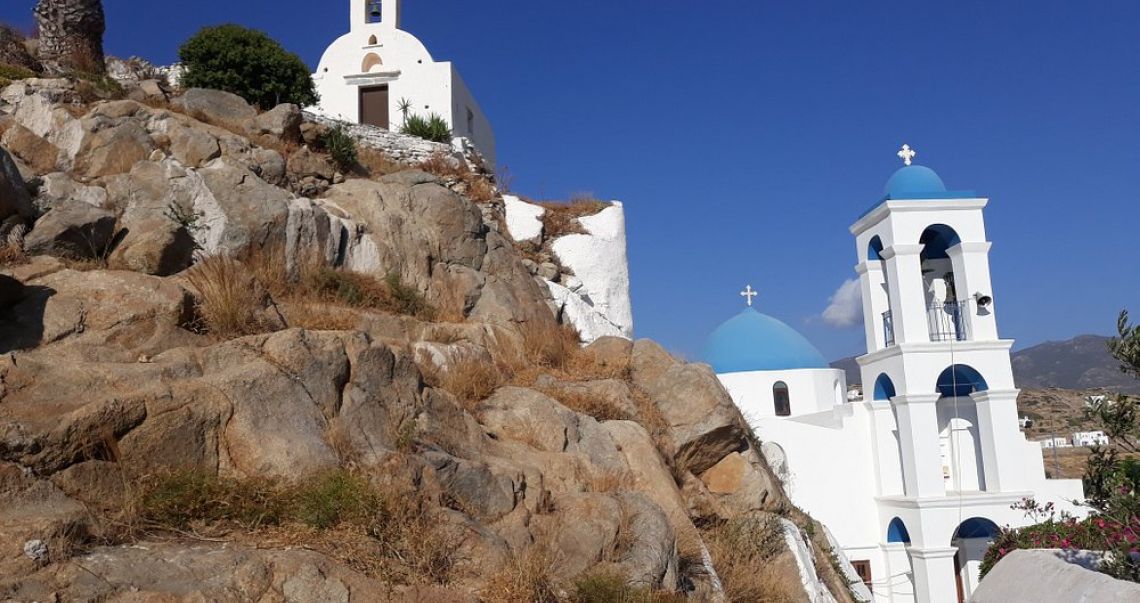
Gialos, also known as Ormos, is the natural harbor of the island and constitutes its second most popular area. The first magical image a visitor gains of Ios as the ship enters the port is the beautiful church of Ag. Eirini (17th century) on the right and Gialos beach on the left. The settlement is built on the foothills with an amphitheatrical view of the sea and has managed to maintain its traditional character and natural beauty.
There is a frequent local bus connection linking the port with Chora and Mylopotas beach (nearly every 15 minutes in the summer), but less frequent connections to the beaches of Koumbaras, Psathi, and Agia Theodoti. Within the settlement, one finds many shops, travel agencies, various restaurants, and cafes. Additionally, just a few meters away, right behind the port, lies the sandy Gialos beach, which offers easy access, clean waters, and ample shade from the surrounding tamarisk trees. The road to the left of the port passes in front of the "Golden Beach" (Chrysi Akti) and continues toward the beautiful beach of Koumbaras. This accessible beach is located to the northwest, a short distance from the port, and constitutes another excellent choice for swimming near Gialos. Another nearby and beautiful beach is Kolitsani.
In addition to the main road connecting Gialos with Chora, there is an old path with many steps that starts behind the port and leads to Chora. It is estimated that you will need about 20 minutes to reach your destination.
Worth seeing: The Monument of Homer, featuring inscribed plaques that clearly prove the great ancient poet's connection to the island; the chapel of Agios Georgios; the Lighthouse at the entrance of the port; and the ruins of the prehistoric settlement on the hill of Skarkos, which dominates the area and is located almost next to the port.
Local excursion boats depart from the port and can take you to the island's more remote beaches, such as Psathi and Agia Theodoti.
CHORA
Chora is the island's only large village, maintaining its traditional character and Cycladic charm to a great extent with its intricate narrow alleys, picturesque arches, small squares, and white-washed houses that show no trace of modern intervention to break the natural harmony with the environment. The dominant color is white, the monotony of which is broken by the colors of the church domes and window shutters. At the summit of Chora stands Panagia Gremiotissa, a Byzantine church with a characteristic palm tree carved into the rock below the castle. Dedicated to the Assumption of the Virgin Mary, it enjoys the most beautiful view to the west, and everyone rightly agrees that the island's most stunning sunset can be seen from there.
Inside Chora, one should visit the Archaeological Collection, housed in the Town Hall, where notable finds and exhibits from the island's historical path can be admired. Also worth visiting are the ruins of the Venetian Castle (built in 1397 AD) erected by Marco Crispi I when he took over the administration of the island and annexed it to the Duchy of Thera. Notable churches include Ai-Nikolas, Agios Georgios, and Agia Aikaterini.
Visit the few remains of the ancient city, where mainly fragments of the foundations of the Temple of Pythian Apollo are preserved near the chapel of Agia Aikaterini. On the southwestern side of Chora, there are remains of the ancient city walls, which are called Cyclopean walls due to their construction. According to researchers, the Agora of the ancient city was located where the churches of Evangelismos and Agioi Anargyroi stand today.
There is also a modern art museum at the Kolitsani location featuring notable paintings from around the world. The modern open-air theater "Odysseas Elytis" is built of stone and marble with a capacity of approximately 1,000 people and an amazing view of the sea, constituting one of the island's most significant cultural elements.
At the edge of Chora, we find the 12 picturesque windmills, which serve as monuments of other eras while adding an aesthetic touch to the modern image of the island.
MYLOPOTAS
Mylopotas is a small settlement stretching along a vast beach on the west of the island, just 3 kilometers from Chora.
It is primarily a summer resort with many restaurants, taverns, bars, and cafes, offering a wide range of water sports, which is why it is the most beloved destination for young people from all over the world.
During the summer, from morning until night, it teems with people enjoying their holidays and having fun.
MAGGANARI
Magganari is a very small settlement with approximately 100 residents located on the southern side of the island, 20 kilometers from Chora, and is surrounded by five small bays with crystal-clear waters and fine sand. Parts of the film "The Big Blue" were filmed there.